
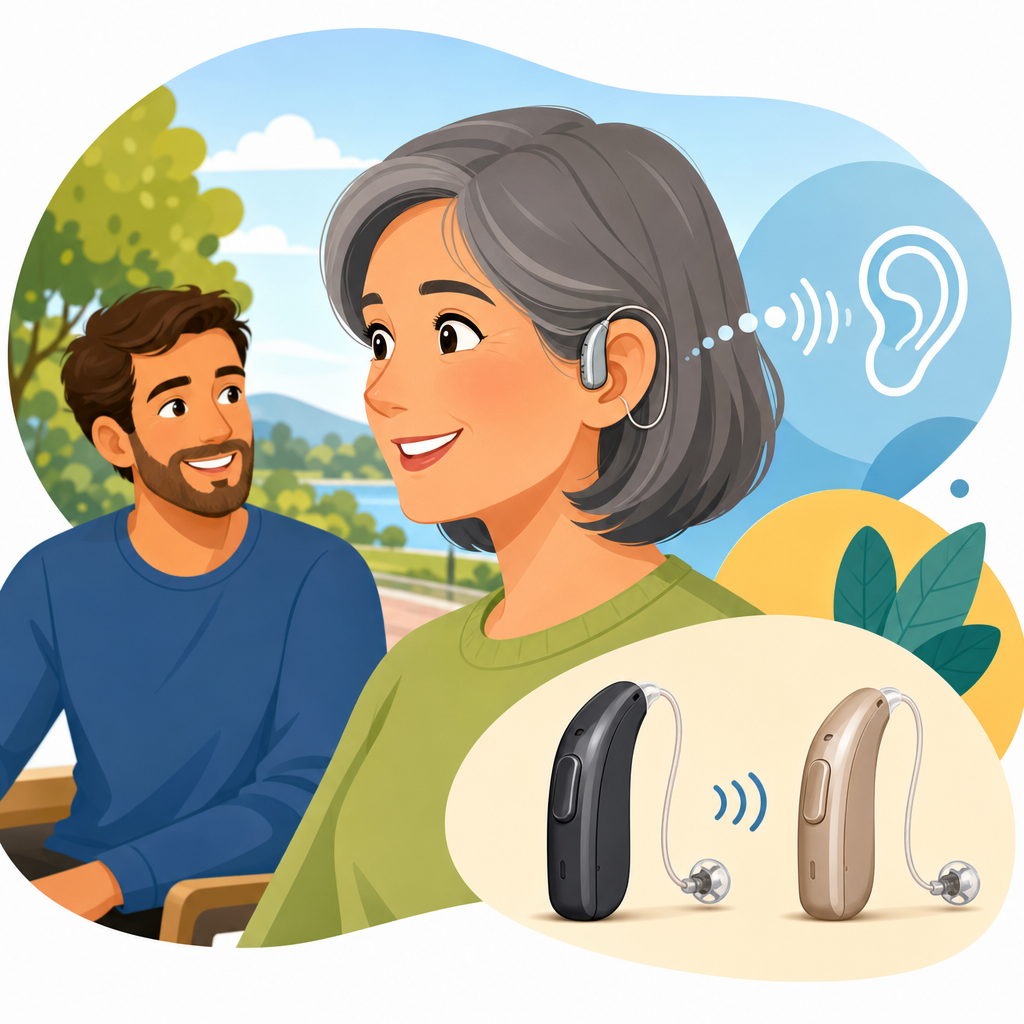
CROS hearing aids are a practical solution for people with single-sided deafness who want better awareness of speech and sound without surgery. In hearing care, CROS stands for Contralateral Routing of Signal. The system places a microphone on the ear with little or no usable hearing and wirelessly sends that sound to a device worn on the better-hearing ear. If the better ear also has some hearing loss, the setup is usually called BiCROS, because the receiving side both amplifies sound and receives the transmitted signal from the poorer ear.
I have fit CROS and BiCROS systems for patients who were frustrated by one problem above all others: they could hear well enough in quiet with their good ear, yet conversations collapsed whenever someone spoke from the deaf side. That pattern is common because unilateral hearing loss removes access to binaural hearing cues. A person may still hear, but they lose the head-shadow advantage, much of their ability to localize sound, and a significant amount of listening ease in restaurants, cars, meetings, classrooms, and family gatherings. Understanding what CROS hearing aids do, what they do not do, and who benefits most is essential before investing time and money.
This guide explains the basics, the fitting process, realistic benefits, limitations, and alternatives. It is designed as a hub page for the broader hearing aids topic, so it covers general concepts comprehensively while pointing you toward the key decisions that matter in real life: candidacy, comfort, battery style, wireless features, microphone performance, and follow-up care. If you are researching CROS hearing aids for yourself, a parent, or an older adult, start here. The goal is straightforward: help you decide whether routing sound from one side to the other is the right strategy for your hearing profile and daily environments.
What CROS hearing aids are and how they work
A CROS hearing aid system has two parts. The transmitter sits on the ear with unaidable hearing and picks up speech, environmental sound, and warning signals on that side. It does not amplify for that ear. Instead, it streams sound in real time to a receiver on the better ear. The receiver presents the signal so the wearer can detect sounds originating from the poor side without turning their head as often. Modern systems from brands such as Phonak, Signia, Oticon, Starkey, and Widex use low-latency wireless transmission, so sound arrives quickly enough to feel natural in conversation.
The key problem CROS addresses is the head-shadow effect. High-frequency consonants like /s/, /f/, and /th/ weaken when they must travel around the head before reaching the better ear. In clinic, I often demonstrate this by standing on a patient’s poorer side and speaking softly. The person misses parts of words, especially in noise. Once the CROS transmitter is activated, access to those speech cues improves because the signal is picked up before the head blocks it. That does not restore hearing in the deaf ear, but it gives the brain access to information it was previously missing.
BiCROS systems work similarly, but the receiver ear also needs amplification. This matters because many adults with single-sided deafness are not young athletes with one perfect ear; they often have age-related hearing loss in the better ear as well. In that case, the fitting must balance transmitted sound from the poor side with amplification needs on the better side. Good programming is not just about volume. It involves gain targets, compression, noise reduction settings, microphone directionality, and the user’s tolerance for mixed signals in complex environments.
Who is a good candidate for CROS or BiCROS
The best candidate for a CROS hearing aid is someone with one ear that has little or no usable speech understanding and one ear with normal hearing or near-normal hearing. Causes include sudden sensorineural hearing loss, acoustic neuroma treatment, Ménière’s disease, congenital unilateral loss, temporal bone trauma, chronic ear disease, or profound loss after infection. A BiCROS candidate has similarly poor hearing on one side but measurable hearing loss on the better side. The exact cutoff varies by audiologist and manufacturer, but speech discrimination, pure-tone thresholds, loudness tolerance, and the patient’s communication demands all matter.
An audiologic evaluation should include air and bone conduction testing, speech reception thresholds, word recognition testing, and, ideally, real-world discussion of listening goals. In stronger clinics, clinicians also measure speech in noise using tools such as QuickSIN or the Hearing in Noise Test. Those tests matter because many patients complain less about pure audibility and more about effort. If a person says, “I can hear, but I cannot follow a conversation when my spouse walks on my bad side,” that is classic CROS territory. If they need restoration of true bilateral input, implantation may be discussed instead.
CROS is often especially useful for people who spend time in meetings, classrooms, retail spaces, religious services, and vehicles. In a car, for example, a passenger seated on the deaf side can be hard to understand because turning the head away from the road is impractical. A CROS microphone captures that speech and routes it to the hearing ear. Parents of children with unilateral loss may also consider CROS in school-age years, though pediatric management requires careful coordination with educational audiology, classroom acoustics, remote microphone systems, and developmental needs.
Expected benefits and realistic limitations
The clearest benefit of CROS hearing aids is improved access to sounds arriving from the poorer side. Users often report fewer requests for repetition, less need to reposition themselves in groups, and more comfort when someone approaches from the deaf side. That improvement can reduce social fatigue. In practice, many successful users describe the result not as “hearing from both ears again,” but as “missing less.” That phrasing is accurate and healthy. It sets expectations around function rather than cure.
There are important limitations. CROS hearing aids do not restore binaural hearing. They do not reliably give back natural sound localization, because both the transmitted sound and the direct sound are still being processed primarily by one functioning cochlea. They also cannot recreate interaural time and level differences that a normal two-eared system uses for spatial hearing. In loud restaurants, performance depends heavily on microphone directionality, seating position, reverberation, and whether the device streams too much unwanted noise from the poor side. Sometimes users need separate programs for quiet, noise, outdoors, and driving.
Another limitation is adaptation. Some people love the immediate awareness CROS provides; others initially find the routed signal distracting, especially in open offices or busy stores. That is why a trial period is critical. In my fittings, the most successful users return after one or two weeks with specific notes: where the system helped, where it felt overwhelming, and whether they preferred stronger or softer transmission. Fine-tuning usually improves outcomes. But if a patient expects perfect directional hearing or dramatic improvement in every noisy place, disappointment is likely unless counseling is thorough from day one.
Comparing CROS hearing aids with other options
CROS is only one management strategy for single-sided deafness. The right choice depends on hearing thresholds, speech understanding, anatomy, medical history, cosmetic preferences, and whether the person wants non-surgical or surgical treatment. Bone conduction devices and cochlear implants are often part of the conversation. Bone conduction reroutes sound through skull vibration to the better cochlea, while cochlear implantation may provide direct stimulation to the poorer ear in selected cases. The differences are clinically significant.
| Option | Best suited for | Main benefit | Main limitation |
|---|---|---|---|
| CROS hearing aids | Single-sided deafness with good hearing in the better ear | Non-surgical access to sound from the poor side | Does not restore true binaural hearing or localization |
| BiCROS hearing aids | Single-sided deafness plus hearing loss in the better ear | Routes sound and amplifies the better ear | More complex fitting and possible listening fatigue in noise |
| Bone conduction devices | Some unilateral losses, conductive issues, or surgical candidates | Reroutes sound without occupying both ears in the same way | Still relies on the better cochlea; may require surgery |
| Cochlear implant for single-sided deafness | Selected patients seeking input to the poorer ear | Potential for better spatial hearing and tinnitus relief in some cases | Surgical pathway, candidacy rules, rehabilitation commitment |
For many adults, CROS is the first option to trial because it is reversible, fast to fit, and easy to compare against unaided listening. If the user wants a non-invasive solution and has realistic expectations, it is often the simplest entry point. If the priority is possible improvement in localization or tinnitus associated with single-sided deafness, an implant conversation may be worthwhile with an otologist or neurotologist. No single route is best for everyone, and a good clinic will explain the tradeoffs without steering every patient toward the same technology.
Features, styles, batteries, and connectivity
Most current CROS hearing aids are receiver-in-canal or slim-tube behind-the-ear designs because they are light, stable, and wireless-ready. Rechargeable models have become common and are usually the right choice for adults who wear devices all day. A full charge often supports a long waking day, but actual runtime depends on streaming, transmitter activity, and how much amplification the better ear requires in BiCROS fittings. Disposable battery models still matter for travelers, people who prefer instant battery swaps, or users who do not reliably place devices in a charger every night.
Connectivity features can strongly affect satisfaction. Bluetooth streaming lets the better ear receive phone calls, media, and video audio, which reduces the need to favor one side physically. Some platforms allow hands-free calling on compatible smartphones. Companion apps may provide program changes, volume balance between routed and local sound, geotagged memories, remote adjustments, and device-finding tools. These are not gimmicks. For a user trying to manage hearing in restaurants, work calls, and outdoor walks, app control can make the difference between abandoning the system and integrating it into daily life.
Microphone strategy is equally important. Directional microphones may help in front-facing conversations, but the fitting has to account for the purpose of CROS: capturing sound from the poorer side. Wind management, impulse noise reduction, feedback suppression, and frequency lowering can all matter depending on the better ear’s needs. In BiCROS fittings, open domes preserve natural hearing when appropriate, while custom molds may improve retention or feedback control. Comfort is not a side issue. If the transmitter or receiver irritates the ear, even excellent technology will sit in a drawer.
Fitting process, follow-up care, and buying advice
A proper CROS fitting begins with a recent diagnostic hearing test and a medical review when indicated. Sudden hearing loss, asymmetry, unilateral tinnitus, dizziness, or neurologic symptoms may require referral before any hearing aid discussion proceeds. Once candidacy is clear, the audiologist selects hardware, couples it to the ears, and programs the receiver according to the better ear’s hearing profile. Verification matters. Real-ear measurement is standard best practice for amplified fittings and helps ensure that BiCROS gain is accurate rather than guessed. Even in traditional CROS, verification of comfort and balance should be documented carefully.
Trial use is where good outcomes are built. I advise patients to test the system in five predictable settings: one quiet conversation, one small group, one noisy public place, one car ride, and one phone or video call. Write down who spoke, where they sat, what improved, and what remained difficult. Those details allow precise adjustments. For example, if restaurant noise from the poor side feels intrusive, the clinician may reduce CROS input in specific programs, alter microphone mode, or add a dedicated speech-in-noise setting. Fine-tuning based on real listening notes works better than general comments like “it’s too much.”
When buying CROS hearing aids, ask about trial periods, warranty length, loss-and-damage coverage, charger replacement cost, dome or wax filter maintenance, and whether follow-up visits are included. Also ask if the clinic supports remote care and if they have experience with single-sided deafness specifically, not just standard bilateral hearing aid fittings. Price varies by technology tier and service model. Premium devices may offer stronger automation and noise handling, but mid-level options can perform very well when the fitting is thoughtful. Choose the provider as carefully as the product, because counseling and adjustments are central to success.
CROS hearing aids solve a specific problem well: they help people with single-sided deafness detect speech and sound from the side that otherwise disappears behind the head. They are not a cure, and they do not recreate natural two-eared hearing, but they often reduce communication breakdowns, listening effort, and social strain in daily life. For the right candidate, that practical improvement is meaningful.
The main decision points are clear. First, confirm candidacy with a full hearing evaluation. Second, decide whether you need CROS or BiCROS based on the hearing level in the better ear. Third, compare non-surgical routing with alternatives such as bone conduction devices or cochlear implantation if your goals extend beyond awareness of the poorer side. Fourth, prioritize fitting quality, verification, and follow-up over marketing claims. Hardware matters, but outcomes depend heavily on programming, counseling, and real-world fine-tuning.
If you are exploring the broader hearing aids category, use this guide as your starting point for the CROS branch of that topic. Bring your hearing test, your daily listening challenges, and your questions to an audiologist who regularly fits unilateral hearing loss. A well-run trial can quickly show whether CROS hearing aids will help you miss less, participate more easily, and move through the world with greater confidence.
Frequently Asked Questions
What is a CROS hearing aid and how does it work?
A CROS hearing aid is designed for people with single-sided deafness or very little usable hearing in one ear and normal or near-normal hearing in the other. CROS stands for Contralateral Routing of Signal. In simple terms, the system places a microphone on the ear that cannot hear well and sends those sounds wirelessly to a device worn on the better-hearing ear. This helps the wearer become more aware of speech, conversation, and environmental sounds coming from the poorer side.
The key benefit is that sound is not “restored” in the non-hearing ear. Instead, it is rerouted so the better ear can pick it up. For example, if someone speaks to you from your deaf side, a CROS system captures that voice and delivers it to your hearing ear, reducing the need to constantly turn your head. Modern systems are typically small, wireless, and designed to work automatically in many daily listening situations. They are especially useful in restaurants, meetings, social settings, walking outdoors, riding in a car, or any environment where important sounds may come from the side with little or no hearing.
Who is a good candidate for a CROS or BiCROS hearing aid?
A CROS hearing aid is generally a good option for someone with unaidable hearing loss in one ear and usable hearing in the other ear. This often includes people with single-sided deafness who struggle to hear conversations or notice sounds coming from one direction. If the better-hearing ear does not need amplification, a standard CROS setup may be appropriate.
A BiCROS system is used when the “better” ear also has some degree of hearing loss. In that case, the device on the better side does two jobs at once: it receives sound from the poorer ear and also amplifies sound entering the better ear. This can be a very practical solution for people who need support on both sides but still rely primarily on one ear for understanding speech.
The best way to know whether you are a candidate is through a full hearing evaluation with a hearing care professional. They will measure hearing levels in both ears, discuss communication challenges, and help determine whether CROS, BiCROS, a traditional hearing aid, or another treatment pathway makes the most sense. Fit, comfort, lifestyle, dexterity, work demands, and listening goals all matter when choosing the right system.
What are the benefits and limitations of CROS hearing aids?
The biggest benefit of a CROS hearing aid is improved awareness of sound from the side with little or no hearing. Many users find that conversations feel easier because they miss fewer words when someone speaks from that side. It can also reduce the constant need to reposition yourself or turn your head to catch speech. In everyday life, this added awareness can make work, social events, family interactions, and travel feel less stressful and more natural.
CROS systems can also help with safety and convenience. Being more aware of traffic, alarms, announcements, or someone calling your name from the poorer side can make day-to-day listening more balanced. Because these devices are non-surgical, they appeal to people who want a practical management option without an implant procedure.
That said, it is important to understand the limitations. A CROS hearing aid does not bring back true hearing in the deaf ear, and it does not fully restore natural directional hearing. Sound is still being processed primarily by one hearing ear, so locating where sound is coming from may remain difficult. Some people also find that in very noisy environments, routing additional sound to the better ear can be challenging until the settings are carefully adjusted. Expectations matter: CROS technology can significantly improve access to sound, but it is not the same as having two fully hearing ears.
Will a CROS hearing aid help with background noise and hearing in busy places?
A CROS hearing aid can help in noisy places, but the answer depends on the listening environment and how the devices are programmed. One of the main advantages is that it allows you to hear speech originating from your poorer side without needing to physically turn toward the speaker. In a restaurant, office, classroom, or family gathering, that can make communication easier and reduce listening effort.
However, background noise remains one of the hardest challenges in hearing care. Since the CROS system sends sound from one side to the better-hearing ear, it may also send unwanted noise along with speech. Modern hearing technology often includes features such as directional microphones, noise reduction, and adaptive processing to improve comfort and speech clarity, but no device can remove all noise completely.
The good news is that professional fitting and follow-up care make a big difference. A hearing care provider can fine-tune the balance between comfort and clarity based on your real-world experience. Many users do very well once the settings are adjusted for their typical environments. The most successful outcomes usually come when people understand that CROS hearing aids improve access to sound and conversation, rather than eliminating every noisy listening problem.
What should I expect when getting fitted for a CROS or BiCROS system?
The fitting process usually begins with a comprehensive hearing test and a conversation about your daily listening needs. Your hearing care professional will evaluate both ears, confirm whether a CROS or BiCROS setup is appropriate, and recommend styles and features that fit your hearing profile, comfort preferences, and budget. They will also explain how the transmitter on the poorer ear and the receiver on the better ear work together.
During the fitting appointment, the devices will be programmed to match your hearing needs and physical ear shape. You will learn how to insert and remove them, charge or replace batteries, clean the microphones and domes, and manage wireless connectivity if the system works with a smartphone or accessories. If you are using a BiCROS system, the amplification on the better ear will also be carefully adjusted so speech is audible without becoming uncomfortable.
Most people need an adjustment period. At first, routed sound may feel different because your brain is getting used to receiving information from the poorer side through the better ear. Follow-up visits are an important part of success, since small changes in volume, microphone behavior, or sound balance can make a meaningful difference. With realistic expectations, practice in everyday environments, and ongoing professional support, many users find that CROS and BiCROS systems offer a noticeable improvement in communication and overall awareness of the world around them.