
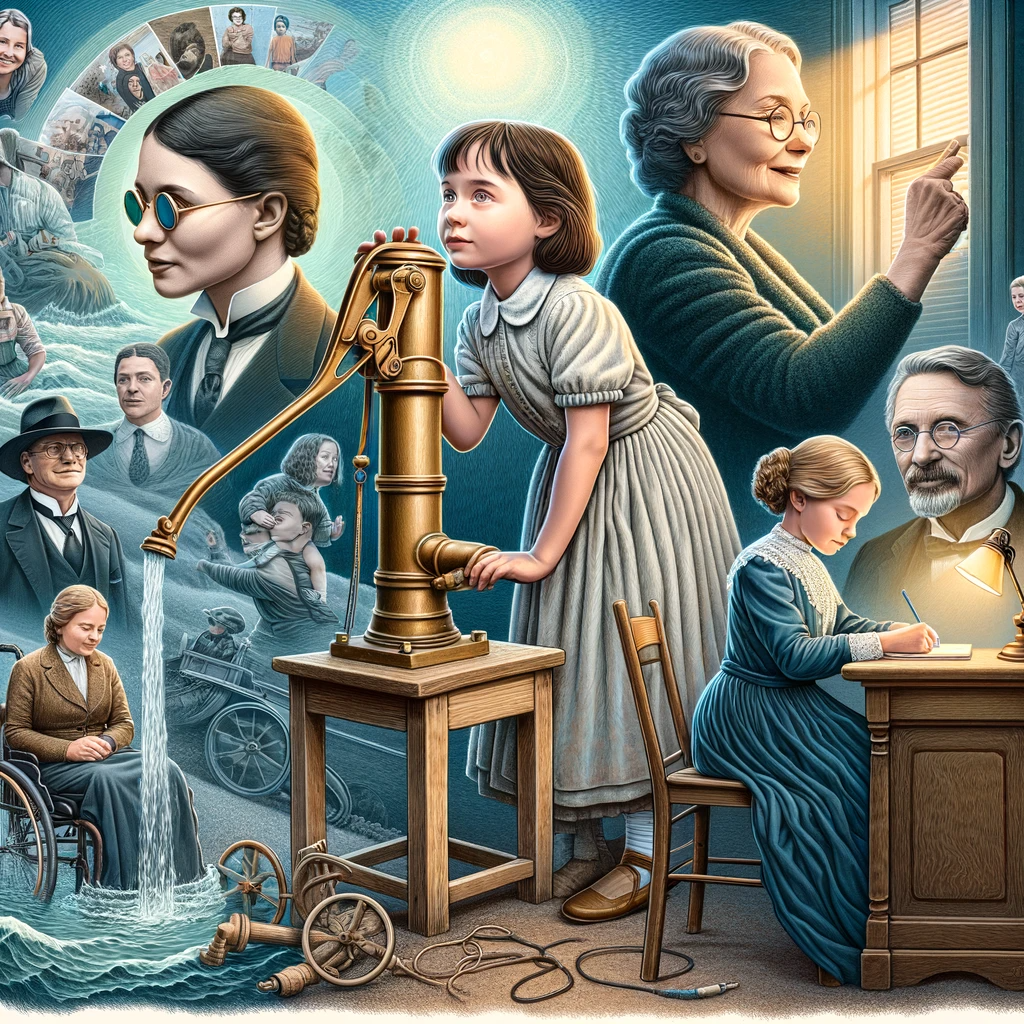
The Extraordinary Journey of Helen Keller
Helen Keller’s life is a testament to the indomitable spirit of human perseverance. Despite being both deaf and blind from infancy, Keller overcame overwhelming obstacles to become one of the most recognized advocates for disability rights, a celebrated author, political activist, and inspiration to millions. This comprehensive guide explores her incredible life story, achievements, and lasting legacy.
Early Life: Tragedy and Triumph
Birth and Early Childhood
Helen Adams Keller was born on June 27, 1880, in Tuscumbia, Alabama. Her parents, Arthur H. Keller and Kate Adams Keller, were well-respected members of Southern society. Helen enjoyed a normal infancy until, at just 19 months old, she was struck by an illness — believed to have been scarlet fever or meningitis — that left her both deaf and blind.
A Silent and Dark World
Without the ability to see or hear, Helen quickly grew frustrated with her inability to communicate. Her behavior became increasingly unruly as she struggled to express herself. Her parents, desperate for help, sought guidance from experts, eventually leading them to a breakthrough that would change Helen’s life forever.
The Arrival of Anne Sullivan: A Life-Altering Connection
Meeting the “Miracle Worker”
In 1887, when Helen was six years old, her parents contacted the Perkins School for the Blind in Boston. They recommended a young teacher, Anne Sullivan, who was partially sighted herself. On March 3, 1887, Anne Sullivan arrived at the Keller household — a date Helen later called her “soul’s birthday.”
The Breakthrough Moment
Anne immediately began working with Helen using finger spelling, spelling words into her hand. The pivotal moment came when Anne spelled “W-A-T-E-R” into Helen’s hand while running water over her other hand. Suddenly, Helen made the connection between the sign and the substance. This was the beginning of her transformation.
Education and Academic Excellence
Early Learning
After mastering finger spelling, Helen quickly learned to read Braille, use tactile sign language, and even learned to speak through tactile lip-reading and vocal exercises. Her insatiable curiosity and thirst for knowledge propelled her education forward at an extraordinary pace.
Radcliffe College and Academic Achievements
In 1900, Helen entered Radcliffe College, the women’s counterpart of Harvard University, with Anne Sullivan by her side, interpreting lectures and assisting with studies. In 1904, she graduated cum laude, becoming the first deaf-blind person to earn a Bachelor of Arts degree.
Helen’s academic journey was not just a personal victory but also a monumental step forward in challenging societal assumptions about what disabled individuals could achieve.
Career as an Author and Lecturer
Publishing Her First Book
Helen Keller published her first book, “The Story of My Life,” in 1903, a memoir detailing her early experiences with Anne Sullivan and her educational journey. The book gained international acclaim and remains a staple of inspirational literature.
A Voice for the Voiceless
Throughout her life, Helen authored 14 books and numerous articles. She traveled extensively, giving lectures and advocating for the rights of people with disabilities. Despite her own speech challenges, her message was powerful, moving audiences around the world.
Advocacy and Social Activism
Championing Disability Rights
Helen Keller was a tireless advocate for the blind and deaf communities. She worked with organizations such as the American Foundation for the Blind (AFB), serving as a spokesperson and raising millions of dollars to support the education and employment of individuals with disabilities.
Political and Social Engagement
Keller’s activism extended beyond disability rights. She was a member of the Socialist Party and an outspoken advocate for workers’ rights, women’s suffrage, pacifism, and birth control. She openly criticized the oppressive structures that marginalized the disabled, poor, and disenfranchised.
Meeting World Leaders
Throughout her career, Helen met and influenced major world figures including Mark Twain, Alexander Graham Bell, Winston Churchill, and Franklin D. Roosevelt. Her global advocacy tours made her a well-known figure in over 35 countries.
Personal Life and Challenges
Friendship and Support
Helen’s relationship with Anne Sullivan was one of deep friendship and interdependence. Even after Anne’s marriage to John Macy, she continued to support Helen’s endeavors until her death in 1936. Later, Polly Thomson, Anne’s former secretary, took over as Helen’s companion and aide.
Love and Loss
Though Helen Keller’s life was rich with friendships, she also experienced romantic love. She fell in love with journalist Peter Fagan in her 30s. However, societal and familial pressures prevented her from marrying, reflecting the era’s stigmas surrounding disabled individuals and their autonomy.
Recognition and Honors
Awards and Distinctions
Helen Keller received numerous awards during her lifetime, including the prestigious Presidential Medal of Freedom awarded by President Lyndon B. Johnson in 1964. She was elected to the National Women’s Hall of Fame at its inception in 1965.
Honorary Degrees and Acknowledgments
Keller received honorary degrees from esteemed institutions worldwide, including Harvard University, Yale University, and universities in Scotland, Germany, and South Africa.
Later Years and Legacy
Continuing Advocacy
Even in her later years, Helen continued her advocacy work, traveling internationally to promote better opportunities for the disabled. She was involved in the founding of organizations that later became the American Civil Liberties Union (ACLU) and remained active until a series of strokes in 1961 forced her to retire.
Death and Commemoration
Helen Keller passed away peacefully in her sleep on June 1, 1968, at her home in Easton, Connecticut, just a few weeks shy of her 88th birthday. Her ashes were interred at the Washington National Cathedral, a rare honor.
The Lasting Impact of Helen Keller
Changing Perceptions of Disability
Helen Keller fundamentally altered public perceptions of people with disabilities. She proved that with education, support, and determination, individuals who are deaf-blind could lead full, influential lives.
Contributions to Education
Her life’s work inspired improvements in special education and accessibility rights. Institutions worldwide continue to honor her contributions through scholarships, schools, and organizations bearing her name.
Media Portrayals and Popular Culture
Keller’s story has been immortalized in books, plays, and films, notably “The Miracle Worker,” which won multiple awards and continues to educate and inspire new generations about the power of perseverance.
Quotes by Helen Keller That Continue to Inspire
“Alone we can do so little; together we can do so much.”
“The only thing worse than being blind is having sight but no vision.”
“Life is either a daring adventure or nothing at all.”
Frequently Asked Questions About Helen Keller
Was Helen Keller completely blind and deaf?
Yes, due to an illness at 19 months old, Helen Keller lost both her sight and hearing. However, she learned to communicate through tactile sign language and later learned to speak.
How did Helen Keller learn to communicate?
Helen’s teacher, Anne Sullivan, used manual sign language, spelling words into Helen’s hand. Helen eventually learned Braille, lip-reading by touch, and even developed her own voice.
What organizations did Helen Keller support?
Keller worked extensively with the American Foundation for the Blind, supported the ACLU, championed women’s suffrage, labor rights, and advocated for world peace.
Did Helen Keller travel internationally?
Yes, Helen traveled to over 35 countries, advocating for people with disabilities and raising awareness about disability rights worldwide.
How is Helen Keller remembered today?
Helen Keller’s legacy lives on through numerous institutions, books, films, educational programs, and the continued fight for disability rights worldwide.
Conclusion: Celebrating an Icon of Hope and Perseverance
Helen Keller’s life defied every limitation society placed on her. Deaf and blind in a world that often marginalized the disabled, she shattered barriers with courage, intelligence, and compassion. Her influence on education, disability rights, and social activism continues to ripple across generations.
As we reflect on her extraordinary journey, Helen Keller remains not just a deaf icon but a universal symbol of hope, determination, and the power of the human spirit.
Frequently Asked Questions About Helen Keller
Helen Keller’s ability to communicate was a remarkable feat given her deaf-blind condition. Initially, she used rudimentary signs to communicate with her family, but this changed significantly with the arrival of her teacher, Anne Sullivan. Sullivan taught Keller the manual alphabet, a form of sign language where letters are spelled onto the palm of the hand. This method was the key to unlocking Keller’s ability to communicate with the world.
Over time, Keller’s communication skills developed exponentially. She learned Braille, which allowed her to read. Keller also mastered speech, despite her inability to hear, through the tactile method of feeling vibrations and movements of the lips and throat. She became proficient enough to give speeches and lectures. Additionally, Keller was an excellent writer, producing several books and articles. Her communication skills, developed through these various methods, allowed her to express her thoughts and ideas eloquently and to advocate effectively for disability rights.
Helen Keller faced significant challenges in her education due to her deaf-blindness. The primary obstacle was communication. Before meeting her teacher, Anne Sullivan, Keller had no formal means of communication or education. Even after Sullivan’s arrival, the process of learning to communicate was arduous and required immense patience and innovation.
Keller’s initial education involved learning tactile sign language and later Braille. Attending formal educational institutions presented another set of challenges. She needed specialized instruction and materials, which were not readily available at the time. Despite these difficulties, Keller was determined to pursue higher education. Her time at Radcliffe College was particularly challenging, as she required all textbooks to be manually transcribed into Braille or read to her, and lectures had to be interpreted through Sullivan’s assistance. However, her determination and intelligence, coupled with Sullivan’s dedicated support, enabled her to overcome these obstacles and graduate with honors.
Helen Keller’s life had a profound impact on changing societal perceptions of disability. Before Keller, expectations for individuals with disabilities, especially those as significant as deaf-blindness, were extremely low. Keller shattered these preconceptions by not only mastering communication but also by excelling academically and becoming a renowned writer and speaker.
Keller’s public life and advocacy brought visibility to the capabilities and potential of people with disabilities. She was a living example that with the right support and opportunities, individuals with disabilities could achieve remarkable things. Her work with organizations like the American Foundation for the Blind and her international tours helped raise awareness and improve the lives of those with disabilities. Keller’s influence played a significant role in the early development of the disability rights movement, paving the way for greater accessibility, education, and employment opportunities for disabled individuals.
Helen Keller was a staunch supporter of the women’s suffrage movement. Her advocacy for women’s rights was interwoven with her work for disability rights and social reform. Keller recognized that women, much like individuals with disabilities, were often denied basic rights and opportunities.
Keller used her platform as a public figure to speak and write in support of women’s suffrage. She was involved with various suffragist groups and participated in rallies and campaigns advocating for women’s right to vote. Keller’s contributions to the movement were significant not only because of her status but also because she exemplified the potential of women to overcome barriers and make meaningful contributions to society. Her involvement in the suffrage movement highlighted the intersectionality of her advocacy, encompassing disability rights, women’s rights, and broader social justice issues.
Helen Keller left behind a legacy that continues to inspire and influence people worldwide. Her life story is a powerful testament to the human spirit’s resilience and the potential to overcome formidable challenges. Keller’s achievements in education, her advocacy for disability and women’s rights, and her extensive writings have had a lasting impact.
Keller’s legacy is evident in the improved rights and opportunities for people with disabilities. Her work laid the groundwork for subsequent legislation, such as the Americans with Disabilities Act. Educational methods and materials for the deaf and blind have evolved, partly due to Keller’s influence. Her story is taught in schools, serving as a source of inspiration and education about disability rights and advocacy. Moreover, organizations like the Helen Keller International continue her work in preventing blindness and reducing malnutrition. Keller’s life encourages ongoing advocacy and awareness for the rights and potential of all individuals, regardless of their disabilities.