
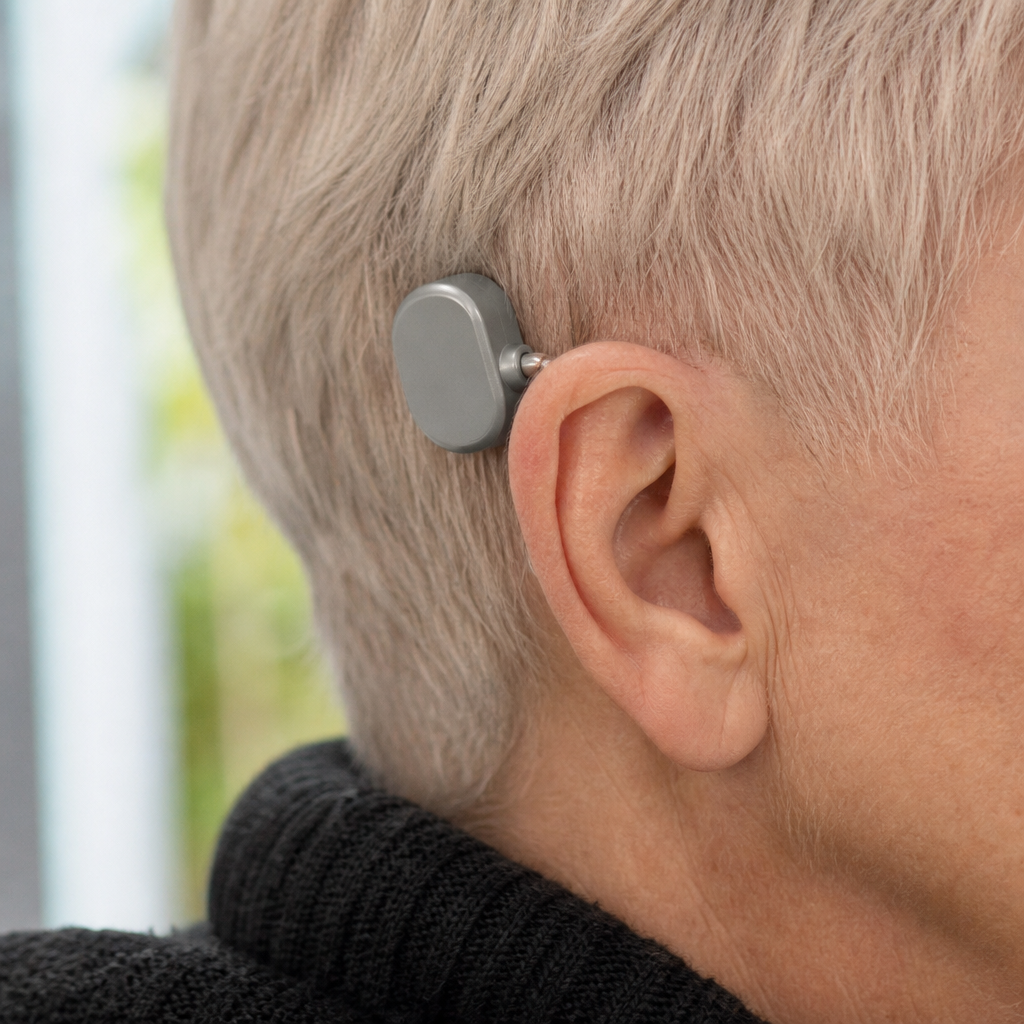
A bone hearing aid is a hearing device that sends sound to the inner ear through skull vibration instead of pushing amplified sound through the ear canal. That difference matters because many people who struggle with traditional hearing aids do not have the same kind of hearing loss, ear anatomy, or medical history. In practice, I have seen bone conduction systems become the most effective option for people with chronic ear infections, congenital ear canal problems, single-sided deafness, and certain conductive or mixed hearing losses that make air-conduction devices uncomfortable or ineffective.
To understand a bone hearing aid, start with three terms. Conductive hearing loss happens when sound cannot travel efficiently through the outer or middle ear. Sensorineural hearing loss happens when the inner ear or auditory nerve is damaged. Mixed hearing loss combines both. A bone hearing aid bypasses much of the outer and middle ear and sends mechanical vibration directly to the cochlea. If the cochlea can still process sound reasonably well, the device can provide access to speech and environmental sound even when the ear canal is blocked, malformed, draining, or medically unsuitable for an in-ear hearing aid.
This topic matters because bone hearing systems occupy an important middle ground between conventional hearing aids and more invasive hearing implants. They can improve hearing, speech understanding in noise, sound awareness on the poorer side, and day-to-day comfort for patients who have often cycled through years of failed earmolds, recurrent infections, and frustration. They also come in several forms: softband or adhesive non-surgical options, percutaneous implanted abutment systems, and transcutaneous systems that connect through the skin with magnets. Knowing the differences helps patients and families ask better questions and choose a device that matches hearing goals, anatomy, age, and lifestyle.
How a bone hearing aid works and who it helps
The core mechanism is simple: a microphone picks up sound, the processor converts it into a vibration pattern, and the vibration reaches the skull bone and then the cochlea. Because the cochlea receives the signal without relying on the eardrum and ossicles in the usual way, bone conduction can overcome many outer- and middle-ear barriers. For a patient with chronic otitis externa or a surgically altered ear canal, that bypass is often the decisive advantage.
The main candidates fall into four broad groups. First are people with conductive hearing loss caused by atresia, microtia, chronic middle-ear disease, ossicular disruption, or postoperative anatomy after mastoid surgery. Second are people with mixed hearing loss who still have enough cochlear reserve for a bone-conduction processor to be useful. Third are patients with single-sided deafness, where routing sound from the deaf side to the hearing cochlea can improve awareness and reduce the head-shadow effect. Fourth are children who need early access to sound before surgery is appropriate, often using a softband system.
A practical example is a child born with unilateral microtia and canal atresia. Air-conduction hearing aids may not be possible on that side because there is no usable canal. A bone hearing aid on a softband can provide auditory stimulation early in development, support classroom listening, and help families assess benefit before considering an implantable option later. Another example is an adult with years of ear drainage from chronic ear disease who cannot tolerate an occluding earmold. In that case, a bone conduction device avoids the canal entirely and often reduces irritation while restoring audibility.
Types of bone hearing aids and how they compare
Not every bone hearing aid is the same, and the distinctions affect comfort, maintenance, candidacy, and performance. Non-surgical systems hold the processor against the skull with a softband, headband, or adhesive adapter. They are commonly used for infants and children, for trial periods, and for adults who want a reversible option. Implanted systems are usually divided into percutaneous and transcutaneous designs. A percutaneous device uses a small titanium implant and abutment that passes through the skin so the processor connects directly. A transcutaneous device places the implant under the skin and uses a magnet or an active transducer to transmit vibration across or within the skin.
| Type | How it connects | Main benefits | Main tradeoffs | Common use case |
|---|---|---|---|---|
| Softband or adhesive | External pressure or adhesive adapter | Non-surgical, easy trial, pediatric friendly | Less efficient transmission, pressure discomfort | Young children, short-term evaluation |
| Percutaneous implant | Direct abutment through skin | Strong transmission, proven long-term outcomes | Daily skin care, visible abutment | Conductive or mixed loss needing maximum output |
| Passive transcutaneous implant | External and internal magnets across skin | No open skin site, cosmetically discreet | Some signal loss through skin, pressure issues | Patients prioritizing appearance and lower skin maintenance |
| Active transcutaneous implant | Internal vibrating transducer under skin | Efficient transmission, intact skin | More complex surgery, specific candidacy limits | Selected conductive, mixed, or single-sided cases |
In clinic, the choice often comes down to output needs, skin tolerance, age, cosmetic preference, and surgical goals. Percutaneous systems typically provide the most efficient vibration transfer because there is no skin dampening between the processor and implant. Transcutaneous systems avoid a permanent skin opening, which many patients prefer, but the skin layer can reduce efficiency, especially at higher power demands. Non-surgical systems are valuable, but headband pressure can be uncomfortable during long wear and performance may not equal an implant.
Brand and platform differences also matter. Widely used systems include Cochlear Baha, Oticon Medical Ponto, MED-EL Bonebridge, and Cochlear Osia. These names are not interchangeable because they use different coupling methods, fitting software, MRI considerations, and power ranges. A good evaluation compares the hearing loss pattern, bone-conduction thresholds, and patient priorities rather than assuming one product is universally best.
Evaluation, fitting, surgery, and daily use
A proper bone hearing aid evaluation begins with a full audiologic workup. That usually includes air- and bone-conduction thresholds, speech testing, tympanometry when relevant, and a medical assessment by an otologist or ENT surgeon. For single-sided deafness, clinicians also confirm the better ear has adequate hearing because the device will route sound to that cochlea. For mixed hearing loss, the key question is whether the cochlea can support useful speech understanding once the conductive component is bypassed.
Whenever possible, patients should trial the sound first. Many clinics offer a demo on a softband or test rod pressed against the mastoid. This is not identical to implanted performance, but it gives a realistic sense of sound quality, loudness, and comfort. I encourage patients to try speech in quiet, then in background noise, and then outdoors where localization challenges become obvious. The best fittings are grounded in lived listening goals: hearing a teacher from the back of a classroom, understanding a partner in the car, noticing traffic on the deaf side, or avoiding constant ear canal irritation.
If surgery is chosen, planning includes imaging in selected cases, skin and bone assessment, and discussion of age-related timing. Implant surgery is generally outpatient. Healing time varies by system, and processor activation can occur weeks later after osseointegration or surgical recovery, depending on the device. Long-term follow-up is not optional. The processor must be programmed to target audibility without distortion, and skin, magnet strength, retention, and comfort all require review.
Daily use is straightforward once the device is fitted correctly. Users put on the processor, check battery or charge level, clean the microphone ports, and keep the attachment site free of buildup. Percutaneous users must be especially consistent with skin hygiene around the abutment. Children need regular reassessment because skull thickness, listening needs, and school environments change quickly. Adults also need periodic hearing tests because mixed hearing loss can progress over time, changing the ideal settings or even the most appropriate technology.
Benefits, limitations, costs, and key questions before choosing one
The main benefit of a bone hearing aid is bypass. If the ear canal or middle ear is the problem, bypassing that pathway can produce clearer access to sound than repeatedly trying larger earmolds, stronger receivers, or medications that do not solve the mechanical issue. For single-sided deafness, the biggest gain is usually awareness from the poorer side and reduced head-shadow effect, not true restoration of binaural hearing. That distinction is important because some patients expect normal localization and are disappointed if counseling is vague.
Speech understanding often improves, but results depend on the hearing profile, processor power, fitting quality, and listening environment. In quiet rooms, many users report immediate benefit. In restaurants and reverberant classrooms, improvement is more variable. Directional microphones, remote microphones, and wireless streaming can help. Many modern processors connect to smartphones, support app-based controls, and integrate with classroom systems or TV streamers, which is especially useful for school-age children and working adults.
Limitations are real. A bone hearing aid does not cure hearing loss, rebuild damaged inner-ear hair cells, or fully replicate natural two-eared hearing in single-sided deafness. Surgical systems carry routine risks such as skin reactions, implant loss, magnet discomfort, numbness, or the need for revision. Non-surgical options can slip, create pressure soreness, or deliver less output. MRI compatibility varies by manufacturer and model, so that question must be addressed before implantation, particularly for younger patients or anyone with ongoing medical needs.
Cost depends on device type, surgery, geography, and insurance rules. In many regions, implanted bone conduction systems may be covered when medical criteria are met, while accessories, upgrades, or replacement processors may involve separate authorization. Families should ask for a written breakdown covering evaluation, surgery, anesthesia, processor, fitting visits, warranty, and future service. They should also ask what alternatives were considered. In some cases, reconstructive ear surgery, conventional air-conduction aids, middle ear implants, CROS systems, or no device at all may be more appropriate. The right decision comes from matching anatomy, audiology, and daily needs with a realistic understanding of benefit.
If you are considering a bone hearing aid, start with an audiologist and an ENT team experienced in bone conduction devices. Ask for candidacy testing, a real-world trial when possible, and clear counseling about expected outcomes. The best choice is the one that improves hearing access, fits medical needs, and remains comfortable enough to wear every day.
Frequently Asked Questions
What is a bone hearing aid, and how is it different from a traditional hearing aid?
A bone hearing aid is a hearing device that delivers sound to the inner ear through gentle vibration of the skull rather than sending amplified sound through the ear canal. This is the key difference between bone conduction devices and traditional hearing aids. A conventional hearing aid makes sound louder and directs it through the ear canal, eardrum, and middle ear. A bone hearing aid bypasses those outer and middle ear structures and sends sound directly to the cochlea, or inner ear, through bone conduction.
That distinction is especially important for people whose hearing difficulty is not caused by a typical sensorineural hearing loss alone. In real-world practice, bone hearing systems are often a better fit for people with chronic ear infections, repeated ear drainage, malformed or absent ear canals, certain cases of conductive or mixed hearing loss, and single-sided deafness. If the ear canal cannot comfortably or safely wear a standard hearing aid, or if sound cannot travel effectively through the normal hearing pathway, a bone hearing aid may offer a more practical and more effective solution.
Bone hearing devices come in different forms, including non-surgical options worn on a headband or adhesive adapter and implanted systems that connect more directly to the bone. Although the designs vary, the goal is the same: to improve access to sound when the usual route through the ear canal is limited, medically inappropriate, or simply less effective.
Who is a good candidate for a bone hearing aid?
A good candidate for a bone hearing aid is typically someone whose inner ear can still receive sound reasonably well, but whose outer or middle ear creates a barrier to hearing through the usual path. This includes people with conductive hearing loss, some forms of mixed hearing loss, chronic ear infections that make traditional hearing aids difficult to wear, congenital ear canal atresia or stenosis, and people with single-sided deafness. In these situations, a bone conduction system can route sound around the problem area and improve hearing access more effectively than a standard device.
Single-sided deafness is one of the most common reasons people explore bone conduction technology. In that case, the device picks up sound from the poorer-hearing side and transmits it through the skull to the better-hearing inner ear. It does not restore hearing in the deaf ear itself, but it can improve awareness of sounds coming from that side and reduce the head-shadow effect, where the head blocks speech and environmental sound from reaching the better ear.
Medical history also plays a major role in candidacy. People with recurring ear surgeries, persistent moisture or drainage in the ear canal, skin problems made worse by in-ear devices, or anatomical differences of the ear may be much better served by a bone hearing aid than by a traditional air-conduction hearing aid. The best way to determine candidacy is through a full hearing evaluation, imaging or medical assessment when needed, and a discussion with an audiologist and, in some cases, an ear specialist. A good fit depends not just on the audiogram, but on anatomy, comfort, communication needs, and long-term ear health.
Are bone hearing aids implanted, or can they be worn without surgery?
Bone hearing aids are available in both surgical and non-surgical forms. Non-surgical options may be worn on a softband, headband, or adhesive attachment and are often used by children, by adults who want to try the technology before committing to surgery, or by people who are not medical candidates for an implant. These options can provide meaningful benefit and are an important part of bone conduction care, especially when a permanent implant is not yet appropriate.
Implanted bone hearing systems involve a procedure in which part of the device is placed in or under the skin so sound vibrations can be transmitted more efficiently to the skull. Some systems use an abutment that connects through the skin, while others are completely under the skin and work through magnetic coupling. The specific type recommended depends on hearing needs, age, anatomy, skin health, lifestyle, and surgeon preference. Each design has its own tradeoffs related to cosmetic appearance, skin care, sound transmission, and daily handling.
Surgery is not automatically better for every person. Many patients do very well with non-surgical bone conduction devices, and these can be especially useful for evaluating whether the listening experience is beneficial before moving forward. If surgery is being considered, the discussion should include expected hearing benefit, healing time, maintenance, MRI considerations when relevant, and the person’s ability to manage the device long term. The best choice is the one that matches both the hearing loss and the individual’s medical and personal circumstances.
What are the benefits and limitations of a bone hearing aid?
The main benefit of a bone hearing aid is that it bypasses the outer and middle ear and delivers sound directly to the inner ear. For the right candidate, that can lead to clearer access to speech, better comfort, fewer problems caused by ear canal irritation, and improved day-to-day hearing in situations where traditional hearing aids have not worked well. People with chronic infections often appreciate not having to block the ear canal, and those with congenital ear differences may find that bone conduction is the most realistic path to improved hearing.
For patients with single-sided deafness, one of the biggest advantages is improved awareness of sounds coming from the side with poorer hearing. This can make conversations easier in certain environments and help with general environmental awareness. For people with conductive or mixed losses, benefit often comes from avoiding the damaged or blocked sound pathway and stimulating the inner ear more directly. Many modern devices also offer wireless connectivity, directional microphones, and better sound processing than older bone conduction systems.
That said, bone hearing aids do have limitations. They do not help every kind of hearing loss equally well. If the inner ear hearing is too poor, bone conduction may not provide enough benefit. In single-sided deafness, the device reroutes sound to the hearing ear but does not recreate true binaural hearing, so sound localization and hearing in noise may still remain challenging. Surgical systems also require medical evaluation and ongoing maintenance. Expectations matter: a bone hearing aid can be life-changing for the right person, but it is not a universal replacement for all hearing devices. Careful testing and counseling are essential to determine realistic benefit.
How do you choose the right bone hearing aid, and what should you expect during the fitting process?
Choosing the right bone hearing aid starts with a comprehensive hearing test and a clear understanding of why traditional amplification may not be the best option. The audiologist looks at bone conduction thresholds, air conduction thresholds, speech understanding, the type and degree of hearing loss, and whether one or both ears are affected. Just as important, they consider medical factors such as chronic infection history, ear anatomy, previous surgeries, skin condition, and whether the person may be a candidate for a surgical solution now or in the future.
In many cases, the fitting process begins with a demonstration or trial using a bone conduction processor on a softband or test band. This helps the patient experience how sound is transmitted and whether speech clarity, comfort, and real-world usefulness are improved. During the fitting, the device is programmed to match the person’s hearing profile, and counseling is provided on what the technology can and cannot do. Patients often need time to adapt, especially if they are new to hearing technology or have been hearing poorly for a long time.
Follow-up care is a major part of success. The best outcomes happen when there is room for adjustment based on real-life listening situations, comfort, retention, and sound quality. If an implanted system is being considered, the process may include coordination with an ear surgeon, imaging in select cases, and a separate activation appointment after healing. Long term, patients should expect ongoing monitoring of hearing, device performance, and listening needs. The right bone hearing aid is not just the newest model or the strongest processor. It is the one that fits the person’s hearing loss, anatomy, medical history, and communication goals in a safe and sustainable way.