
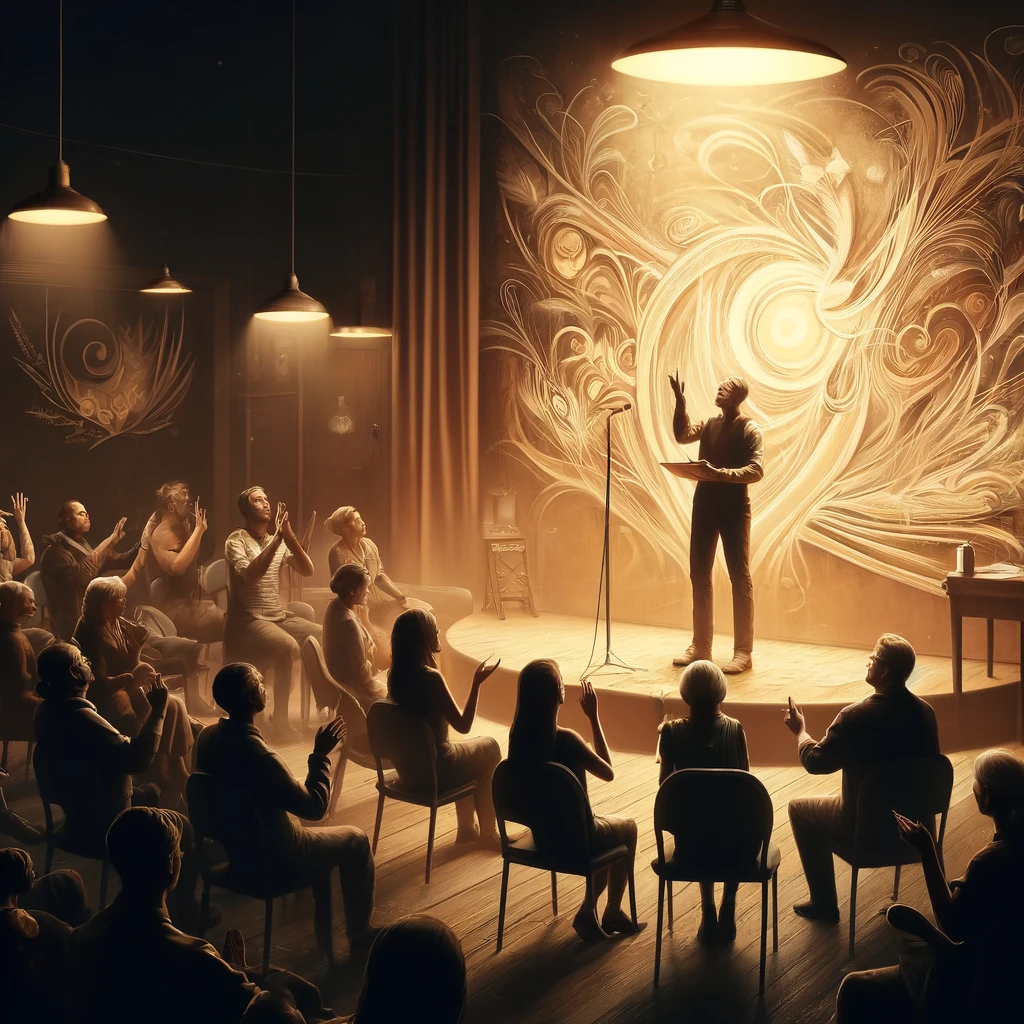
The world of poetry and storytelling is rich and diverse, encompassing various forms and languages. Among these, American Sign Language (ASL) poetry and storytelling stand out as unique and powerful art forms. They provide insight into the Deaf community’s experiences, creativity, and resilience. This article delves into the realm of Deaf poets and the art of ASL storytelling, celebrating the rich tapestry of expression they offer.
The Essence of Deaf Poetry
Deaf poetry breaks the bounds of traditional auditory poetry, creating a visual, spatial, and gestural language that communicates emotions and stories in a dynamic and expressive way. Unlike oral poetry, which often relies on vocal inflection to convey emotion, Deaf poetry uses hand shapes, movements, and facial expressions. This approach to poetry enriches the art form with a new dimension of expression, where visual rhyme and movement take precedence over auditory aspects. The evolution of Deaf poetry has been shaped by poets like Douglas Ridloff, who founded ASL SLAM, a platform that encourages the Deaf community to explore and celebrate their language through poetry and storytelling. Ridloff emphasizes the importance of movement and visual rhythm in ASL poetry, offering a different lens through which poetry can be experienced and appreciated.
Innovations in ASL Storytelling
ASL poetry and storytelling have witnessed significant innovation over the years. One notable approach is Visual Vernacular (VV), a theatrical technique that communicates through body movements, facial expressions, and gestures. This form of expression is akin to cinema, where the performer manipulates movements and space, much like a camera zooming in and out. VV allows stories to be told visually, without the need for spoken language, and is increasingly popular in both Europe and the US. ASL Slam, equivalent to an MC battle, showcases this technique, demonstrating its potential to captivate audiences regardless of their familiarity with sign language.
Impactful Voices in Deaf Poetry
Several Deaf poets have made significant contributions to the landscape of ASL poetry and storytelling. For instance, Meg Day’s poetry explores the intersection of deafness, gender, and identity, challenging the typical metaphor of silence in hearing poetry and redefining it through a Deaf lens. Day’s work highlights the unique experiences and perspectives of the Deaf community, offering a poignant critique of how deafness is often perceived and portrayed in mainstream culture.
John Lee Clark, a DeafBlind poet and critic, has been instrumental in highlighting the richness of Deaf poetry. His work displaces the conventional focus on sound in poetry, putting sign language and the cultural conventions of the Deaf community at the core. Clark’s poetry invites readers to embrace the communication styles that define the Deaf community, enriching the literary world with self-awareness and vivid sensory detail.
Bridging the Gap Between Worlds
Efforts to bridge the gap between the Deaf and hearing communities are integral to ASL poetry and storytelling. Douglas Ridloff, through his TEDx talks and performances, has been pivotal in making ASL poetry more accessible and relatable to a broader audience. He emphasizes the importance of expression and the transformative power of finding freedom through one’s native language of ASL. Ridloff’s work in ASL poetry not only showcases his creative talent but also serves as a bridge, inviting those unfamiliar with ASL to appreciate and understand its richness and complexity.
ASL Poetry: A Reflection of Deaf Culture
ASL poetry is more than an art form; it’s a reflection of the Deaf community’s culture, history, and experiences. It encompasses various styles, including handshape stories, which use the shapes of letters, numbers, or other handshapes to tell a story. This aspect of Deaf literature plays a vital role in the cultural and linguistic education of Deaf children, akin to how hearing children learn language through songs. ASL poetry, in its many forms, provides a canvas for the Deaf community to express their cultural feelings and experiences, creating visual images that can be appreciated even by those not familiar with ASL.

Pioneers and Innovators of Deaf Poetry and ASL Storytelling
The landscape of Deaf poetry and ASL storytelling is marked by pioneers and innovators who have contributed significantly to its evolution. Adrean Clark, for example, has been pivotal in developing ASLwrite, a written form of ASL that captures its visual-spatial essence. This method allows ASL poetry to be experienced on paper, providing a unique and accessible medium for engagement. Clark’s innovative approach demonstrates the versatility of ASL and its potential to transcend traditional modes of expression.
Rachel Mazique, a Deaf literature scholar, has also made significant strides in defining and expanding the scope of Deaf literature. Her work in exploring the evolution of Deaf literature is crucial in understanding how ASL poetry and storytelling have developed over time, and how they continue to impact the Deaf community and the broader literary world.
Celebrating Diversity within Deaf Poetry
Deaf poetry and storytelling are not just about language; they are deeply intertwined with the identities and experiences of Deaf individuals. This art form offers a unique platform for exploring various aspects of identity, including gender, race, and disability. Poets like Meg Day use their work to delve into these themes, providing a nuanced and intimate portrayal of life as a Deaf individual navigating a world often dominated by ableist narratives. Day’s poetry stands as a powerful testament to the diversity and complexity within the Deaf community.
The Role of Technology and Digital Platforms
In the digital age, technology plays a crucial role in the dissemination and preservation of Deaf poetry and storytelling. Digital platforms provide a space for ASL poets to share their work, reach a broader audience, and foster a sense of community among Deaf artists and enthusiasts. Patrick Boudreault’s contributions to the Deaf Studies Digital Journal are a prime example of how digital media can be utilized to promote and preserve ASL poetry in its purest form, ensuring that the essence of this unique language is not lost in translation.
The Theatricality of ASL Poetry
The performance aspect of ASL poetry and storytelling is as crucial as the written or signed word. The use of body language, facial expressions, and spatial movement creates a theatrical experience that transcends conventional poetry readings. Performers like Douglas Ridloff have shown that ASL poetry is not just an act of communication but a full-bodied performance that engages audiences in a multisensory experience. This theatricality adds depth and dimension to the poems, making each performance a unique and immersive event.
Educational Implications of ASL Poetry
ASL poetry and storytelling also play a significant role in education, both within the Deaf community and beyond. They serve as tools for cultural and linguistic education, allowing Deaf children and adults to connect with their heritage and language. Moreover, these art forms provide an avenue for hearing individuals to learn about and appreciate Deaf culture, fostering greater understanding and inclusivity. The incorporation of ASL poetry in educational settings can enhance language acquisition and cultural awareness, making it a valuable component of both Deaf and mainstream education.
Conclusion
Deaf poets and ASL storytellers have carved out a vibrant and dynamic space in the world of arts and literature. Their contributions have not only enriched the cultural tapestry of the Deaf community but also challenged and expanded the boundaries of poetry and storytelling as a whole. The fusion of language, performance, and technology in ASL poetry and storytelling showcases the ingenuity and resilience of Deaf artists. As we continue to explore and embrace these powerful forms of expression, we celebrate the diversity and depth of human creativity, bridging gaps between communities and fostering a deeper appreciation for the myriad ways in which we communicate and connect.
References
- “The Noblest Gift”: The Fight to Preserve American Sign Language Poetry Takes Center Stage at CUNY Graduate Center. Poetry Society. Poetry Society Article
- Sound Consequence by Meg Day. Poetry Foundation. Poetry Foundation Article
- An Ear for Poetry. Poetry Foundation. Poetry Foundation Article
- Douglas Ridloff at Play: The Poet Brings ASL Slam to the World. City of Asylum. City of Asylum Article
- Deaf American Poetry. Gallaudet University Press. [Gallaudet University Press Article](https://gupress.g[University Press Article](https://gupress.gallaudet.edu/bookpage/DEAFAMPOET-bookpage.html)
- Deaf Poetry: Expanding the horizons of poetic expression. HearingLikeMe. HearingLikeMe Article
- Deaf Culture Values: Art and Literature. Start ASL. Start ASL Article